Healthy snacks for weight loss: a label-smart US grocery guide
 By Clement7 min read
Find the controversial ingredients already in your kitchen.
Scan packaged foods at home, understand ingredients, and find healthier alternatives in seconds.



 Scan with Osana
The short answer
The most useful healthy snacks for weight loss are the ones that keep you full on fewer calories, which in practice means protein plus fiber plus water volume: Greek yogurt with berries, cottage cheese on whole-grain crackers, a hard-boiled egg with fruit, roasted chickpeas, edamame, or an apple with a tablespoon of nut butter. When you are buying packaged snacks, the fastest screen is a label check: aim for roughly 150 to 250 calories per serving, at least 5 g protein or 3 g fiber, added sugars under about 6 g, and an ingredient list you can read out loud without stumbling.
No single snack causes weight loss. What snacks can do is make the rest of your day easier, so you arrive at dinner hungry rather than ravenous, and you skip the 4 p.m. vending machine spiral.
Why protein and fiber matter more than calorie count alone
Low calorie healthy snacks only work if they actually satisfy you. A 100-calorie pack of thin cookies and a 100-calorie serving of cottage cheese are not interchangeable in how long they hold.
Protein is the most satiating macronutrient in controlled feeding studies, and higher-protein eating patterns are consistently associated with better appetite control. Fiber adds bulk and slows gastric emptying, and most Americans fall well short of recommended intakes, according to the Dietary Guidelines for Americans. Water content matters too: whole fruit, raw vegetables, and yogurt weigh more per calorie than crackers, which is part of why they feel like more food.
So the working formula for filling healthy snacks is simple:
- A protein anchor (dairy, eggs, legumes, fish, nuts, or a clean protein powder)
- A fiber source (fruit, vegetables, whole grains, beans, seeds)
- A little fat for staying power, not the whole snack
Whole-food snacks that do the heavy lifting
These need almost no label reading, which is why they belong at the top of the list.
Plain Greek yogurt or skyr with frozen berries. Around 15 to 20 g protein per cup. Buy plain and add fruit yourself, since flavored tubs often carry 12 to 18 g of added sugar. If you want help comparing tubs, the top-scoring yogurt breakdown is a useful shortcut.
Cottage cheese. Two percent cottage cheese runs roughly 12 to 14 g protein per half cup. Savory version: cottage cheese, cracked pepper, cherry tomatoes. Sweet version: cinnamon and diced pear.
Hard-boiled eggs. Six grams of protein for 70 calories, sold pre-peeled at Costco and Trader Joe's if boiling feels like a project.
Edamame. Frozen shelled edamame gives about 18 g protein and 8 g fiber per cup, ready in five minutes.
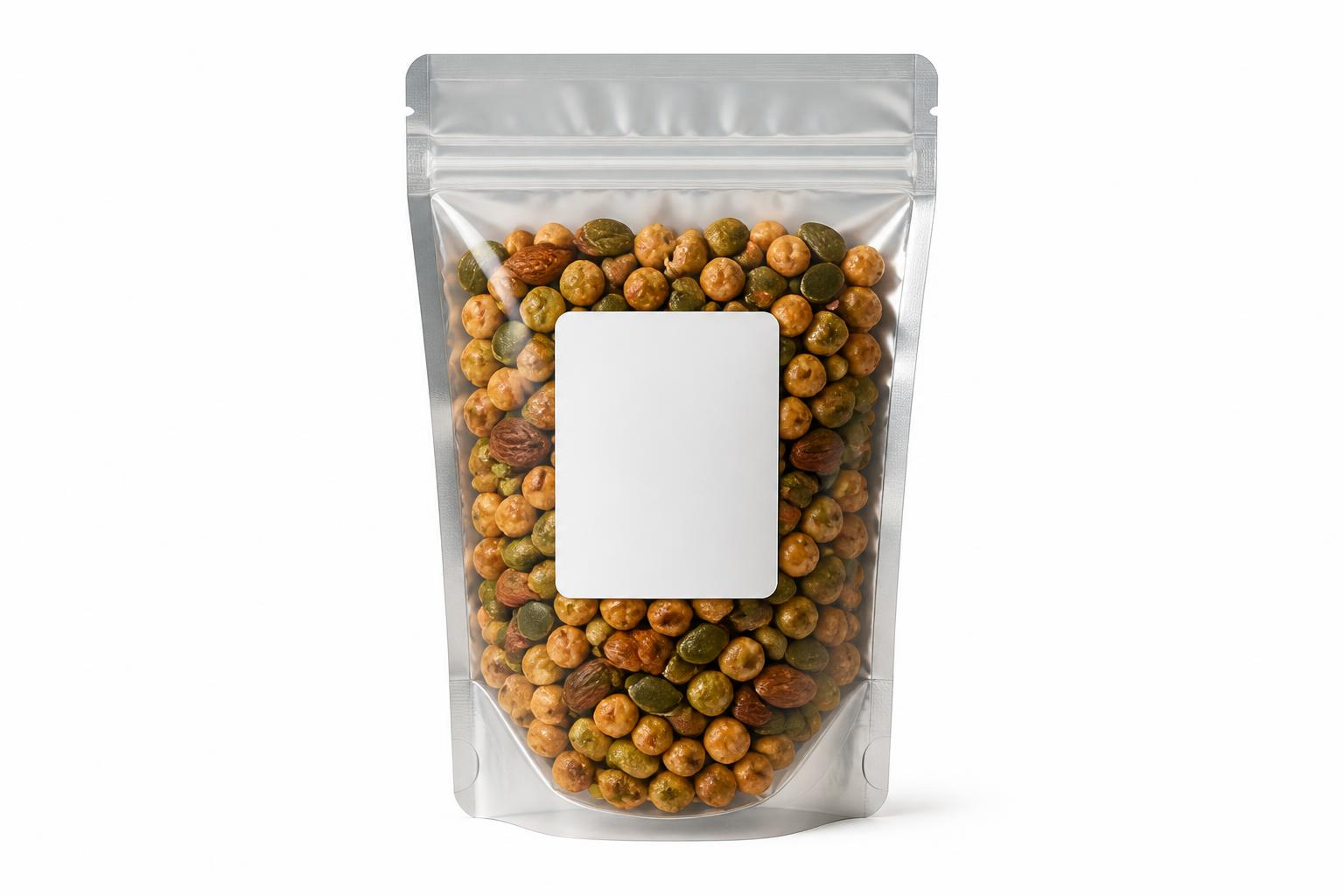
Roasted chickpeas and lupini beans. Crunch with fiber attached. Lupini beans, now common at Whole Foods and Trader Joe's, are unusually high in protein for a shelf-stable snack.
Apple, pear, or clementines with nuts. A medium apple plus 15 almonds is around 190 calories with 4 to 5 g fiber.
Tinned fish on seedy crackers. Sardines and salmon pouches from Trader Joe's or Walmart pair omega-3s with protein.
Vegetables with hummus or tzatziki. Cheap volume. Pre-cut mini peppers, snap peas, and Persian cucumbers hold up in a lunch bag.
How to read a packaged snack label in 30 seconds
Most of the confusion in the snack aisle comes from front-of-package language, not from the actual nutrition data. "Keto," "plant-based," "made with real fruit," and "no artificial anything" are marketing positions, not nutritional standards. Flip the box.
Step 1: check the serving size. This is the most common trap. A bag of veggie straws or a "single" granola pouch is frequently two or three servings. The FDA explains serving size basics in its guide to reading the Nutrition Facts label.
Step 2: scan protein and fiber. If both are under 3 g, you are buying a snack that will leave in 40 minutes.
Step 3: look at added sugars, not total sugars. The yogurt's own lactose and the fruit's fructose are not the issue. Added sugars are listed separately now, and the American Heart Association suggests a daily ceiling of about 25 g for women. One granola bar can quietly use a third of that.
Step 4: use %DV as a speed tool. Five percent or less is low, 20 percent or more is high, which is handy for fiber (want high) and sodium (usually want lower). Our %DV explainer covers the shortcuts.
Step 5: read the last third of the ingredient list. That is where you find the emulsifiers, gums, artificial colors, and flavor systems that mark a product as heavily reformulated. A lot of shopper interest in additives right now, including the attention driven by MAHA-adjacent food content online, comes down to this one habit. It is worth noting that regulatory approaches differ: some colors and additives permitted in the US are restricted or require warning labels in the EU, which the European Food Safety Authority documents in its re-evaluation work.
Packaged snacks worth putting in the cart
Categories, not brand worship, since formulations change.
Single-serve nut and seed packs. Portion control without willpower. Look for nuts, salt, and nothing else. Dry roasted is fine.
Protein bars with short labels. The best healthy snacks for weight loss in bar form usually have 10 to 20 g protein, at least 3 g fiber, and under 8 g added sugar. Watch the sugar alcohol content if you are sensitive to it. If bars are your default, the protein bar buying guide narrows the field.
Seed and whole-grain crackers. Check that a whole grain or seed is the first ingredient, then pair with cheese or hummus rather than eating them solo.
Plain popcorn. Air-popped or lightly oiled, three cups for about 100 calories with 3 g fiber. Skip the butter-flavored microwave versions if you are watching sodium.
Freeze-dried or unsweetened dried fruit. Satisfies a sweet craving. Confirm there is no added sugar or sulfite-heavy coating, and remember that dried fruit is calorie dense by volume.
Jerky and meat sticks. High protein, often high sodium. Compare the sodium %DV across two brands before you commit.
Frozen fruit bars and Greek yogurt bars. A reasonable dessert-shaped snack when the ingredient list is fruit, dairy, and not much else.
Three practical timing habits
- Pair, do not eat solo. Carbs alone spike then crash. Fruit plus protein is the fix.
- Pre-portion on Sunday. Put nuts in small containers. The bag is the problem, not the nuts.
- Snack on purpose, around 3 to 4 p.m. A planned 200-calorie snack often prevents a 600-calorie unplanned one.
The bottom line
Weight management is driven by your overall eating pattern, sleep, movement, and stress, not by a single hero snack, and individual needs vary enough that it is worth checking with your own clinician or a registered dietitian before making big changes. What you can control at the store is quality: more protein, more fiber, fewer mystery ingredients, honest serving sizes. If you would rather not read six labels in the cracker aisle, you can scan the barcode with Osana and see the additives, ultra-processed markers, and cleaner alternatives in a couple of seconds.
FAQ
How many calories should a weight-loss snack be? Most people do well with 150 to 250 calories, enough to actually bridge a gap between meals. A 100-calorie snack with no protein tends to be a false economy.
Are nuts too high in calorie for weight loss? They are calorie dense, but they are also filling and their fat is not fully absorbed. The issue is portion, so measure about a quarter cup or buy single-serve packs.
Is fruit a good snack if I am cutting sugar? Whole fruit brings fiber, water, and micronutrients along with its natural sugar, which is very different from added sugar in a cookie. Pair it with protein for longer staying power.
Do I need to snack at all? No. Some people manage hunger better on three solid meals. Snacks are a tool for people who get too hungry between meals, not a requirement.
What is the fastest way to compare two snack boxes in the aisle? Divide protein plus fiber by calories in your head. The box with more grams of protein and fiber per 100 calories, and the shorter ingredient list, is usually the better buy.
Choose cleaner swaps before they land in your cart.
Use Osana at Whole Foods, Trader Joe's, Target, Costco, or Walmart to compare labels faster and shop with more confidence.