NOVA food classification: the 4 groups explained with US grocery examples
 By Clement7 min read
Find the controversial ingredients already in your kitchen.
Scan packaged foods at home, understand ingredients, and find healthier alternatives in seconds.



 Scan with Osana
What the NOVA food classification actually is
The NOVA food classification is a system that sorts foods into four groups based on how much and what kind of industrial processing they have been through, not by calories, fat, or sugar. It was developed by researchers at the University of Sao Paulo in Brazil and is used in nutrition research worldwide, including in the Pan American Health Organization and in several national dietary guidelines. In plain terms: NOVA asks "what was done to this food and what was added to it?" rather than "how many grams of fat does it have?"
That is why a can of plain chickpeas and a bag of chickpea puffs can look similar on a macro chart but sit in completely different NOVA groups.
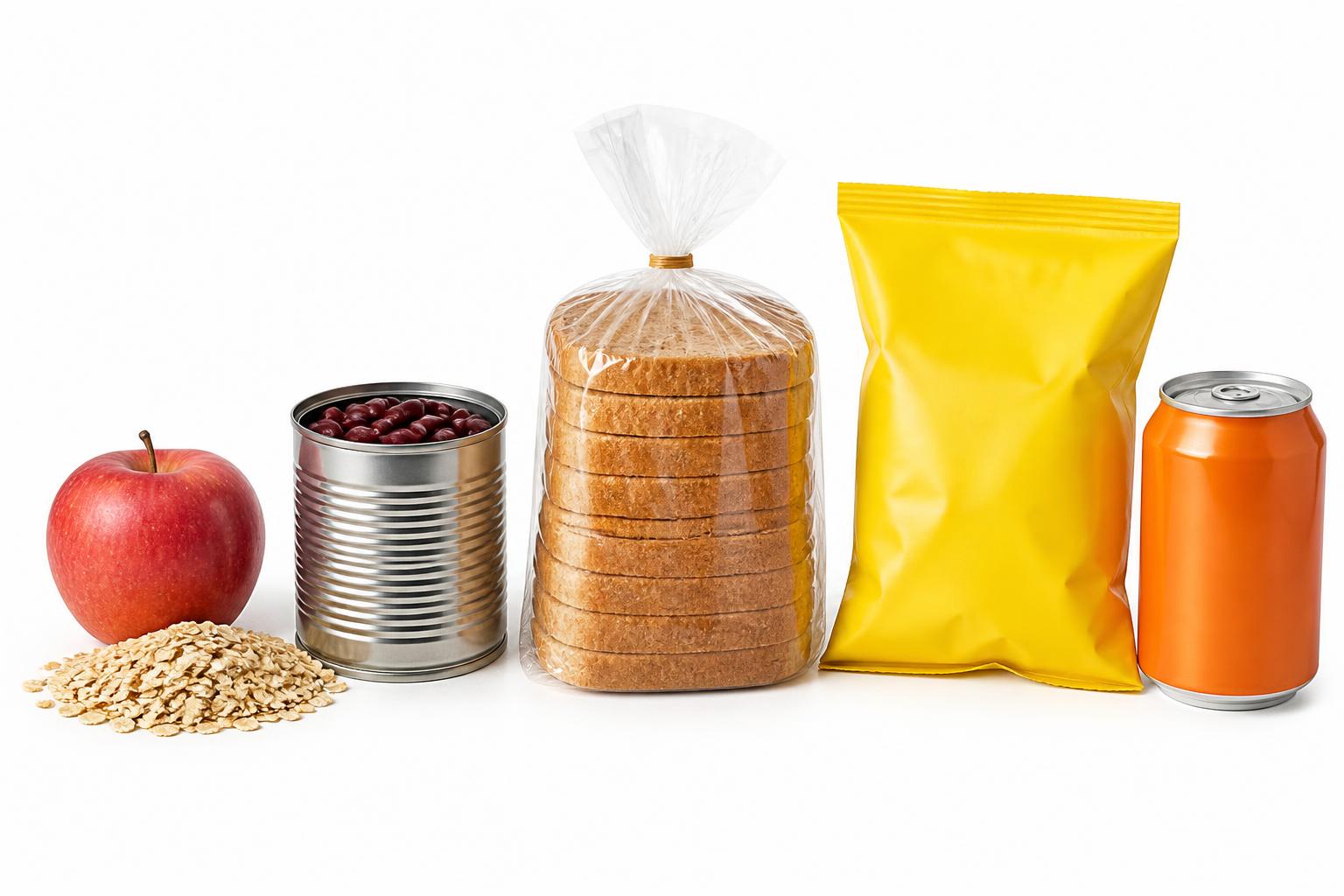
The four NOVA food groups, with what you would actually put in your cart
The NOVA classification system uses four categories. Here is how they translate to a Target, Costco, or Trader Joe's run.
NOVA 1: unprocessed and minimally processed foods
Whole foods, plus foods changed only by drying, grinding, roasting, freezing, pasteurizing, or vacuum packing, with nothing added.
Examples: bagged spinach, bananas, frozen wild blueberries, plain rolled oats, raw almonds, whole milk, plain Greek yogurt with only milk and cultures, dried black beans, fresh chicken breast, eggs, plain frozen broccoli, coffee beans, plain pasta made from durum wheat and water.
NOVA 2: processed culinary ingredients
Substances extracted from group 1 foods or from nature, used in kitchens to cook and season. You rarely eat them alone.
Examples: olive oil, butter, table salt, sugar, honey, maple syrup, vinegar, cornstarch.
NOVA 3: processed foods
Group 1 foods with group 2 ingredients added, usually for preservation or flavor, typically with a short ingredient list you could reproduce at home.
Examples: canned tomatoes with salt, canned tuna in olive oil, jarred olives, most traditional sourdough and simple breads, block cheddar, salted roasted peanuts, canned chickpeas, plain smoked salmon, jarred sauerkraut.
NOVA 4: ultra-processed foods
Industrial formulations made largely or wholly from substances extracted from foods or synthesized in labs, usually with additives whose job is to make the product hyper-palatable, shelf stable, and cheap to produce.
Signals on the label: high fructose corn syrup, protein isolates, maltodextrin, hydrogenated or interesterified oils, modified starches, emulsifiers like polysorbate 80 or mono- and diglycerides, artificial or "natural" flavors, colorings, non-nutritive sweeteners, thickeners, and bulking agents.
Examples: most breakfast cereals, flavored yogurt cups with modified starch and colors, soda and diet soda, packaged cookies and snack cakes, chicken nuggets, instant noodles, most store bread with dough conditioners, many protein bars, powdered drink mixes, and most frozen pizza.
If you want a deeper walkthrough of what counts and why the definition is argued over, our guides on healthy packaged snacks and aisle-by-aisle healthy food swaps show how this plays out in a real cart.
How to tell NOVA 3 from NOVA 4 at the shelf
This is the only boundary most shoppers struggle with, and it is the one that matters. Three quick label checks:
- Scan for ingredients you would never keep at home. Salt, yeast, olive oil, vinegar, and spices are kitchen items. Soy protein isolate, sodium stearoyl lactylate, and caramel color IV are not. One or more of the second kind usually pushes a product into NOVA 4.
- Count cosmetic additives, not just preservatives. A preservative in canned tomatoes serves safety. Colors, flavors, and emulsifiers mostly serve texture, appearance, and craveability, which is the defining feature of group 4.
- Ignore front-of-pack claims. "Organic," "made with real fruit," "plant based," and "no artificial colors" tell you nothing about NOVA group. An organic toaster pastry is still NOVA 4.
Two real comparisons: plain canned black beans with beans, water, and salt are NOVA 3, while a shelf-stable bean-and-cheese burrito with modified corn starch, distilled monoglycerides, and natural flavor is NOVA 4. Block mozzarella is NOVA 3, while individually wrapped cheese slices with sodium citrate and color added are NOVA 4.
What the research says, and what it does not
Large observational studies have linked higher ultra-processed food intake with higher risk of obesity, cardiovascular disease, and all-cause mortality. A widely cited umbrella review in The BMJ assessed 45 meta-analyses and found consistent associations, though the authors graded much of the evidence as low or very low certainty. A small but important NIH inpatient trial found people ate roughly 500 more calories per day on an ultra-processed diet than on a minimally processed one matched for macronutrients, which suggests processing itself, not just nutrient content, can influence intake.
Honest caveats worth holding onto:
- Most evidence is observational. People who eat more ultra-processed food also tend to differ in income, cooking time, smoking, and physical activity, and researchers can only partly adjust for that.
- NOVA is a blunt instrument. Whole grain packaged bread, fortified soy milk, and a candy bar can all land in group 4, and nobody seriously argues they are nutritionally equivalent.
- Convenience has real value. Frozen vegetables, canned fish, and simple packaged foods make weeknight dinners possible, and the goal is reducing the least useful group 4 items, not eliminating packaging.
- The WHO still frames dietary guidance primarily around sugars, sodium, saturated fat, and fiber, which remain the clearest levers.
US consumer interest in additives, EU-restricted ingredients, and food policy has grown sharply in recent years and features heavily in MAHA-adjacent content online. NOVA is useful context for those conversations, but it is a research tool for population studies, not a safety verdict on any single product.
Using NOVA without overhauling your whole kitchen
A practical approach that survives a busy week:
- Anchor the cart in groups 1 and 3. Produce, plain dairy, eggs, dried or canned legumes, frozen vegetables, nuts, plain grains, simple cheese, canned fish.
- Pick your two highest-volume NOVA 4 categories and upgrade only those. For most US families that is breakfast cereal and snacks, or soda and bread.
- Read the ingredient list before the Nutrition Facts panel. The panel tells you quantity, the ingredient list tells you identity. Pairing this with our guide to reading %DV fast covers both in under a minute per product.
- Accept a floor. Some group 4 food in the week is normal and not a failure.
Conclusion
NOVA 1 2 3 4 is best understood as a lens, not a scorecard: it tells you how far a product is from a home kitchen, which turns out to correlate with a lot of things worth caring about, while still leaving room for judgment about individual foods. Use it to shift the balance of your cart toward whole and simply processed foods, keep expectations realistic about what the evidence proves, and let the Nutrition Facts panel handle the rest. If you would rather not decode emulsifier names in the cereal aisle, scanning a barcode with Osana surfaces the additives and processing signals in a couple of seconds.
FAQ
Is every NOVA 4 food unhealthy?
No. The group includes fortified plant milks and some whole grain breads alongside soda and candy. NOVA measures processing, not nutritional quality, so pair it with the ingredient list and the Nutrition Facts panel.
Is NOVA used officially in the United States?
Not in the Dietary Guidelines for Americans, which are organized around food groups and nutrients. Brazil, Uruguay, Israel, and several other countries reference processing levels in their national guidance, and US agencies have begun formally exploring a definition of ultra-processed food.
Where do protein powders and meal replacement shakes fall?
Almost always NOVA 4, since they rely on isolated proteins, sweeteners, gums, and flavorings. That does not automatically make them a poor choice for a given person, it just means they are industrial formulations rather than whole foods.
Does home cooking with processed ingredients count as ultra-processed?
No. Cooking group 1 foods with group 2 ingredients like olive oil and salt keeps the meal in the minimally processed territory. Adding a jarred sauce with modified starch and flavorings brings a group 4 component into an otherwise simple dish.
Choose cleaner swaps before they land in your cart.
Use Osana at Whole Foods, Trader Joe's, Target, Costco, or Walmart to compare labels faster and shop with more confidence.